




Maintaining a Current Bike & Pedestrian Data Inventory for Active Transportation Planning
See how the Greater Madison MPO leverages Ecopia's high-precision bike facilities, sidewalk, & crosswalk data to efficiently update GIS data for active transportation planning.

The importance of high-precision bike and pedestrian data
Metropolitan planning organizations (MPOs) rely on comprehensive, accurate, up-to-date transportation data to understand how infrastructure connects people to jobs, schools, and essential services. Analyzing geospatial transportation data highlights gaps in safety, connectivity, and accessibility, enabling MPOs to make informed decisions about how transportation networks evolve to serve dynamically changing communities. However, these insights are only usable if they reflect reality.
When data is outdated, incorrect, or incomplete, it becomes significantly harder to prioritize investments, measure progress, and demonstrate compliance with federal and state requirements. Inaccurate data can have especially serious impacts on bike and pedestrian route safety and accessibility. Without regularly updated geospatial inventories of sidewalks, shared-use paths, protected bike lanes, and crosswalks, MPOs risk planning around infrastructure that no longer reflects on-the-ground conditions. This can lead to inaccurate safety analyses and missed opportunities to close critical network gaps.
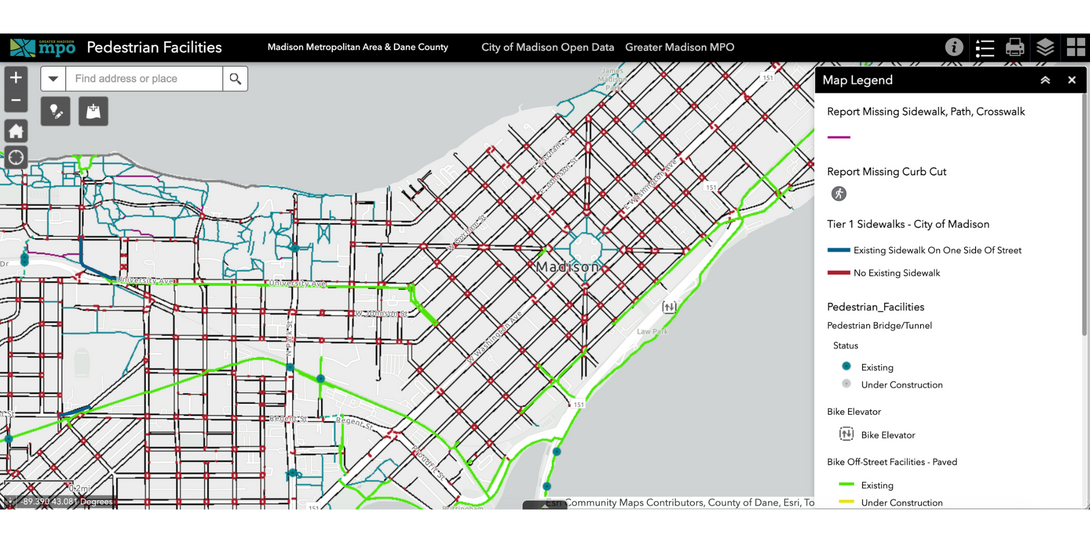
However, maintaining a current geospatial inventory of highly detailed infrastructure is no small task. Active transportation networks are inherently dynamic, making data maintenance a constant priority. Each year, new bike lanes are striped, bike paths are constructed, sidewalks are added or repaired, crosswalks are upgraded to ADA standards, and traffic-calming measures are installed. Traditional data maintenance methods require geospatial representations of these features to be manually identified and traced from the most recent imagery, a highly resource-intensive process that leaves many MPOs with a tough choice: risk using outdated data or divert resources from planning initiatives to data maintenance.
The challenge: maintaining a current bike and pedestrian database in a dynamically changing world
The Greater Madison MPO serves 36 cities, towns, and villages across over 446 square miles in Dane County, Wisconsin - a growing region home to over half a million people. Responsible for enhancing transportation options, improving the accessibility and sustainability of their transportation system, and promoting an exceptional quality of life for all, the MPO creates and maintains maps and geospatial datasets for key infrastructure, travel patterns, future planning efforts, and more. As these assets are frequently used by local communities, planners, and the public for transportation-related decision-making, keeping them current with reality across the growing region is a top priority.
Historically, the Greater Madison MPO has relied on staff knowledge, reporting by local communities, and manual imagery inspection to maintain an up-to-date database of bike and pedestrian facilities. This data underpins a variety of the MPO’s planning initiatives, such as an updated active transportation plan for Dane County and a library of interactive maps that show the public where pedestrian and bike routes are located.
“The reality of manual data creation and maintenance is that in the time it takes to review, analyze, and digitize imagery, real-world change has potentially taken place,” said Dan Seidensticker, GIS Specialist at the Greater Madison MPO. “This can render the data outdated before it is even put to use, and require even more resources to fix.”
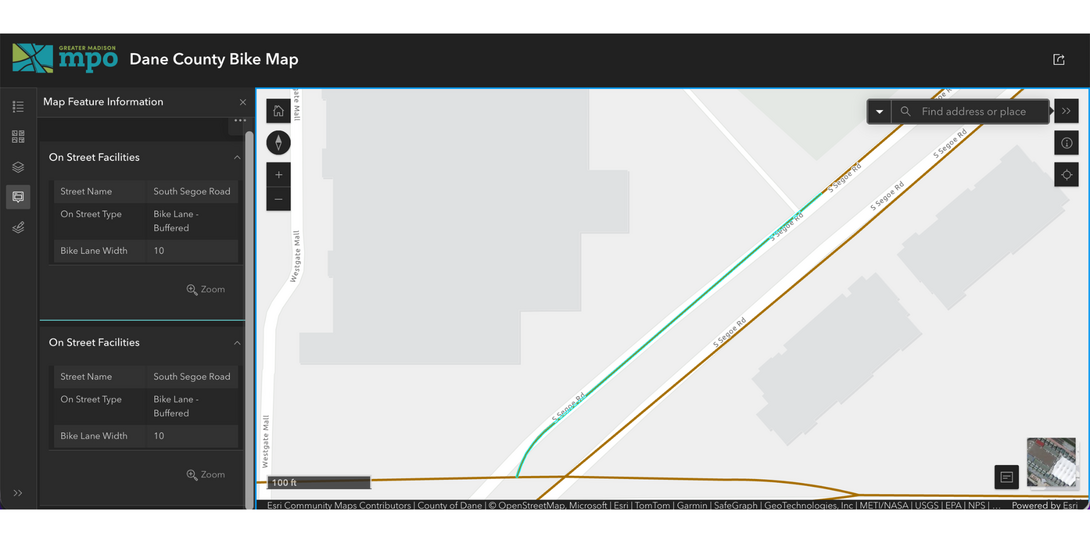
While traditional data maintenance methods were sufficient in the past, they have been extremely resource-intensive, leading the MPO to look for a way to supplement their process with a more scalable and efficient way to identify and update new or missing features in their database.
The solution: AI map feature extraction
After researching possible solutions, the Greater Madison MPO ultimately chose to source AI-powered bike and pedestrian data from Ecopia AI (Ecopia). Founded in 2013, Ecopia has a long history of supporting 100+ MPOs in AI-powered geospatial data creation for transportation planning.
Leveraging Dane County’s 3-inch aerial orthophotography, Ecopia’s AI map engine extracted 14 unique geospatial layers critical to active transportation planning, such as bike path and sidewalk centerlines and truncated dome detectable warning surfaces.
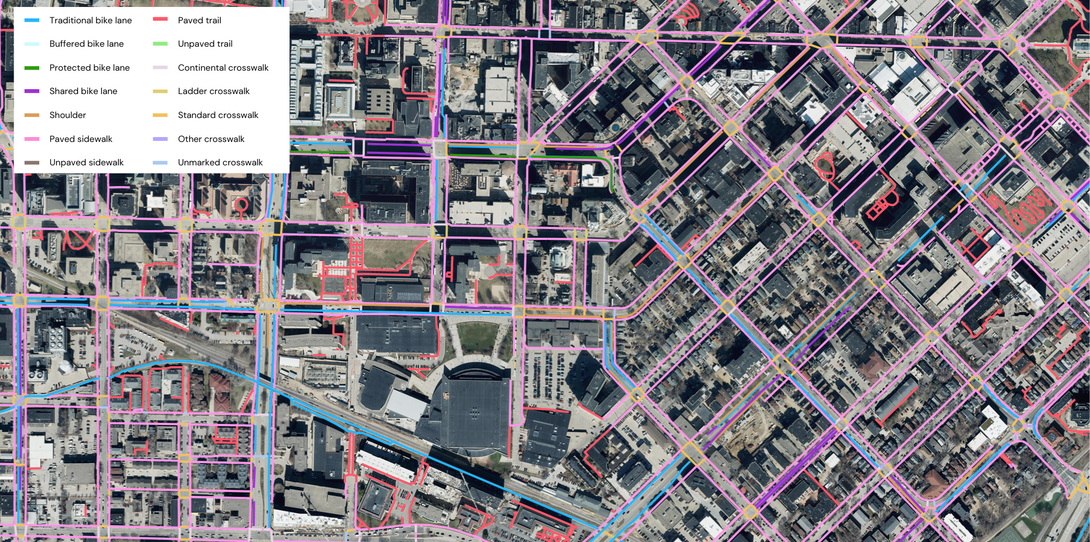
Extracted in a matter of weeks, the Ecopia dataset encompasses 2,400+ miles of sidewalk, 236+ miles of crosswalk, and other essential planning features - all with >95% geometric accuracy. Many features also include width attribution, an important metric for bike and pedestrian safety and accessibility.
Manually reviewing imagery, tracking changes, and digitizing features to update the MPO’s database at this scale would have taken several months of effort by both full-time staff and interns.
“Ecopia’s AI feature extraction greatly reduced the time and effort required to keep our pedestrian and bike asset inventory up-to-date,” said Seidensticker. “This not only helped us optimize our resource allocation, but also ensured the data was as current and accurate as possible for our planning efforts.”
To refresh their existing database with the Ecopia data, the GIS team at the MPO overlaid existing data with the newly extracted vectors in ArcGIS Pro. In addition to using feature comparison and select by location tools, the team members visually inspected areas to look for differences and missing features, ensuring their inventory reflects reality.
The result: a digital inventory of bike and pedestrian facilities
The Greater Madison MPO’s updated bike and pedestrian database informs a diverse list of planning initiatives with the up-to-date, accurate insights needed to allocate resources effectively and further the MPO’s mission. It also allows the MPO to create interactive mapping experiences to drive engagement with the general public.
For example, the MPO maintains an interactive low-stress bike route finder that enables the public to map a bike route based on levels of traffic stress (LTS) scores, which factor in elements like vehicle speed limits and bike lane type.
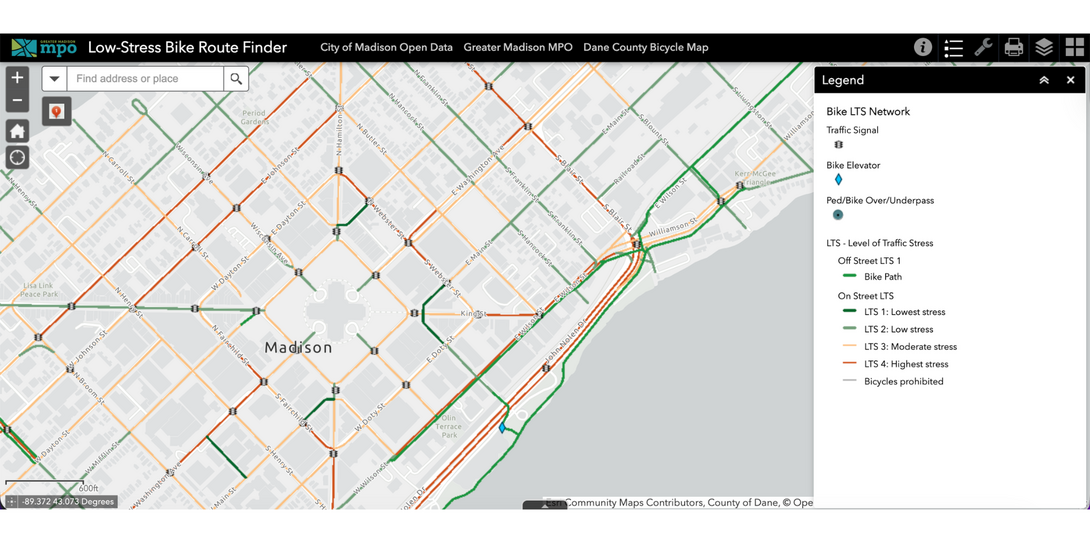
“We take pride in the detail and accuracy of the map and data assets we provide to both government stakeholders and the general public,” said Seidensticker. “The tools we are able to create with high-precision and up-to-date data help foster more livable communities in our region, directly contributing to our organization’s mission.”
What’s next?
Looking ahead, the Greater Madison MPO is developing a new active transportation plan to replace one created in 2015. Leveraging the updated geospatial data alongside survey feedback from the community, the plan will outline the safety and comfort needs of people pursuing active modes of transportation and provide planners and decision-makers with a practical framework for designing more effective streets, sidewalks, and shared-use paths - especially as e-bikes become more commonplace.
With the high-precision digital inventory of pedestrian and bike facilities from Ecopia, the MPO is well-positioned for a future of effective, data-driven transportation planning. With up-to-date information on streets, sidewalks, bike lanes, bike paths, and other infrastructure assets, the MPO can make informed decisions that prioritize safety, accessibility, and efficiency for all users. This data enables scenario modeling, targeted investments, and proactive maintenance planning, ensuring that the region’s transportation network evolves in step with growth and community needs.
To learn more about Ecopia’s transportation data solutions, get in touch with our team.
Ready to get started?
