

Ecopia's Building-Based Geocoding now includes delivery point validation (DPV), a USPS-maintained signal that independently confirms whether a geocoded address corresponds to a real, deliverable location. The addition of DPV builds upon Ecopia’s multi-layered accuracy framework that makes Ecopia's geocoder fundamentally different and ~40% more accurate than other geocoders on the market. This blog breaks down what that means and why it matters for data teams in insurance, emergency response, broadband planning, and beyond.
What is delivery point validation?
Delivery point validation (DPV) is a USPS-certified process that verifies whether a given address actually exists and is deliverable. It's not about whether an address sounds correct, but rather a check against the USPS master address file to confirm that mail can be delivered to that specific location.
When a geocoded address point passes DPV, it means two independent systems agree: the geocoder placed the address at the right location, and the USPS recognizes that location as a legitimate, deliverable address. For data teams that rely on address accuracy, that agreement is a significant indicator of data quality.
How Ecopia's Building-Based Geocoding works
Most geocoders derive address locations in one of two ways: by interpolating along road centerlines and estimating where an address falls based on known address ranges on a street segment, or by plotting an address at the geographic center (centroid) of the parcel the address falls on. These are reasonable approximations, but still just that: approximations. The result is a point somewhere near the building, not anchored to it. Geocoders built with street-level or parcel centroid methodologies are typically 58% accurate.
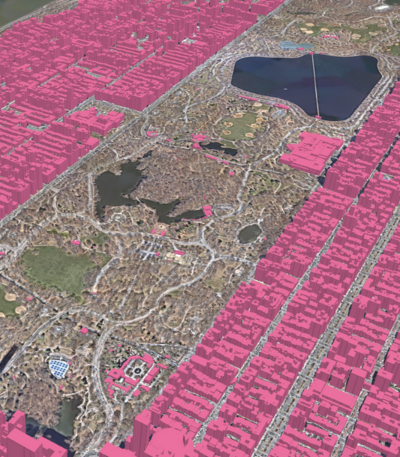
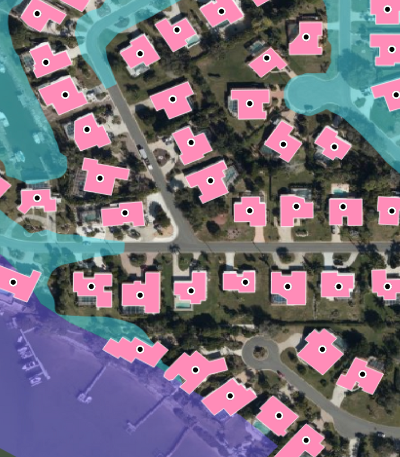
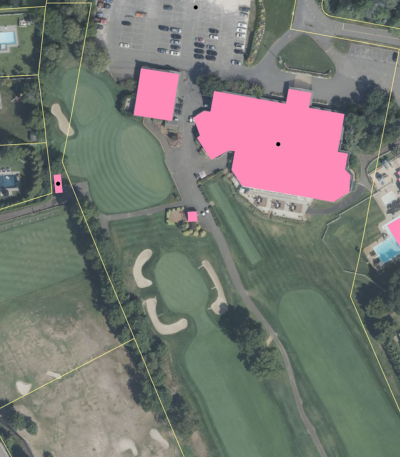
Ecopia's approach is different. Our AI map engine extracts building footprints directly from current high-resolution imagery and prioritizes deriving every address point from the actual structure on the ground. The result is a geocoding database that identifies where an address is located on Earth’s surface with 97% accuracy.
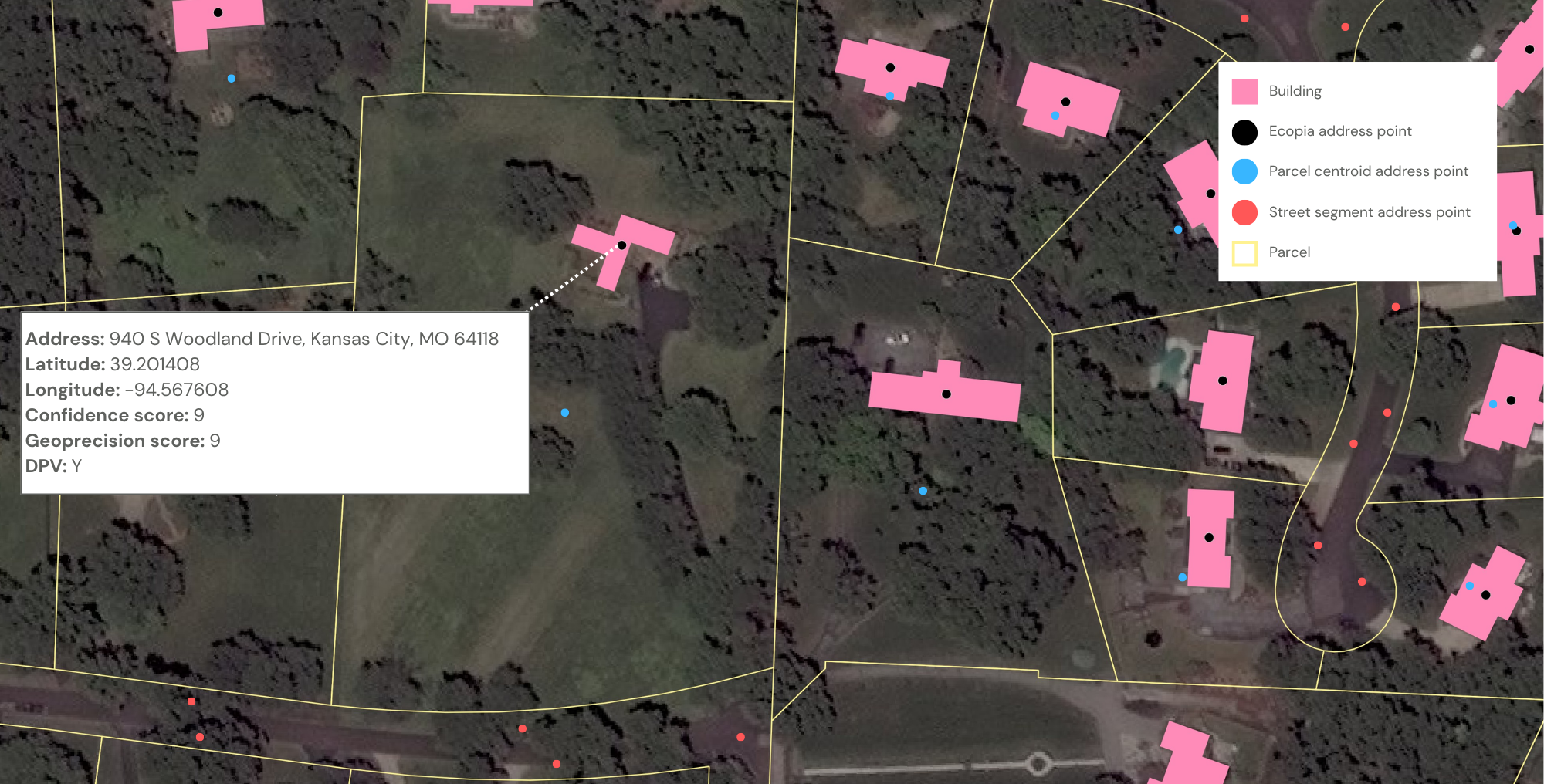
No geocoder will ever be perfect. Address data is messy by nature: structures get built before addresses are formally assigned, structureless properties can still be addressable, and address records in source databases contain errors that no geocoding methodology can fully correct for. Ecopia acknowledges this reality, which is why every address point in our dataset includes multiple accuracy signals indicating the health of that specific geocode. Rather than presenting a coordinate as a take-it-or-leave-it output, we give data teams the indicators they need to understand what they're working with and make informed decisions about how to use it.
A multi-layered geocoding accuracy framework
The inclusion of DPV is just one part of a broader accuracy framework built into every Ecopia address record. Our geocoder surfaces multiple signals that data teams can use to understand and act on the quality of each location.
Geocoding confidence score
Every Ecopia address carries a confidence score ranging from 1 to 9. This score reflects the accuracy of the address latitude/longitude coordinates and the degree to which the address passes multiple address validation tests. Every address in the Ecopia dataset has at least one source confirming that the address is valid, so even the lowest confidence scores represent addresses that cleared a baseline validation threshold. The score gives data teams a numeric handle on how much weight to place on any given record, which is useful for filtering, flagging, or prioritizing downstream analysis.
Geocoding precision score
Alongside confidence, each address also carries a precision score from 1 to 9 that reflects the spatial resolution of the geocoded location. This score is based on a combination of geoprecision accuracy metrics, including the accuracy of the address coordinates and the type of geometry associated with the location (whether the point is anchored to a building footprint, a parcel boundary, a street segment, etc.). A building-anchored point with a high precision score tells a very different story than a street-interpolated point at the low end of the scale. For use cases where locational precision matters, like risk assessment, dispatch routing, and infrastructure planning, the precision score provides the transparency needed to make key distinctions.
Delivery point validation (DPV)
DPV, the newest addition to the dataset, adds external confirmation from the USPS that an address is real and deliverable. Where confidence and precision scores reflect Ecopia's internal assessment of a location's quality, DPV is an independent third-party check. When all three signals align (high confidence, high precision, and a passing DPV result), data teams have a robust, multi-source basis for trusting a location record.
Why geocoding accuracy indicators matter
For any organization that makes decisions based on where something is, geocoding accuracy has operational consequences. A coordinate that looks correct but is off by 200 feet can place a property in the wrong risk zone, send a first responder to the wrong structure, or miscount a serviceable location in a broadband funding application. The problem is not just inaccuracy. It's invisible inaccuracy. When a geocoder returns a point with no indication of how reliable it is, bad data moves through workflows unchallenged.
Accuracy indicators change that dynamic. When every address record includes signals for confidence, precision, and external validation, data teams can filter, triage, and audit their location data rather than treating all geocodes as equally trustworthy. High-stakes records can be flagged for review. Low-confidence addresses can be held out of automated workflows. Portfolio-wide quality can be measured and tracked over time. The indicators make the data usable in ways that a bare coordinate cannot.
Geocoding accuracy indicators in P&C insurance: property risk assessment

In property and casualty (P&C) insurance, geocoding accuracy is not an abstract data quality concern; it has direct underwriting, claims, and reinsurance consequences. When a policy is written to a geocoded location, that coordinate determines which risk models, flood zones, wildfire hazard scores, and catastrophe model outputs apply to that property. A point that falls on the wrong side of a flood zone boundary, or on the wrong parcel, can mean a policy is rated for the wrong risk entirely. In CAT-prone regions, the difference between an accurate building-based coordinate and an interpolated road-centerline estimate can be hundreds of feet, and hundreds of feet matter when a property sits near a hazard boundary.
Ecopia's confidence and precision scores give P&C data teams a structured way to identify and handle lower-quality records before they flow into risk models. Rather than treating all geocoded addresses as equally reliable, teams can use precision scores to distinguish building-based points from street-level interpolations and use confidence scores to flag records that may warrant additional validation. DPV adds a further check: when an address point passes DPV, teams have greater assurance that the location corresponds to a real structure and a real deliverable address, not a geocoded artifact, a mis-keyed entry, or an unverifiable address record.
See how Harford Mutual uses Building-Based Geocoding to strategically group properties for reinsurance.
Geocoding accuracy signals in emergency services routing: a safety issue

For emergency dispatch, the geocoded location of an address is the starting point for everything that follows. When a call comes in, the address gets geocoded, and that coordinate determines which unit is dispatched, how routing is calculated, and how long it takes responders to arrive. If the geocode is wrong, first responders go to the wrong place.
Building-based geocoding directly addresses one of the most persistent failure modes in emergency dispatch: the gap between where an address geocodes and where the structure actually is. In rural and low-density areas, this gap is especially consequential. Interpolated road-centerline geocodes can place a structure hundreds of feet off its actual location (on the wrong side of a driveway, at the wrong end of a long rural address range, on a different parcel entirely, etc.).
Precision scores make this distinction explicit: a high precision score tied to a building footprint tells dispatch systems and their administrators that the point is anchored to the structure, not estimated from the road or parcel. Confidence scores help agencies identify records that may need remediation before they surface in a live dispatch event. DPV provides a USPS-sourced check that the address is real and recognized, helping agencies catch bad address records before they produce dangerous geocodes.
Learn how CAL FIRE uses Ecopia geocoding and land cover data to inform fire mitigation and response.
Geocoding accuracy signals in telecommunications: informed broadband expansion

Broadband deployment planning depends on knowing exactly where serviceable locations are. Federal programs like the Broadband Equity, Access, and Deployment (BEAD) program allocate funding based on how many unserved or underserved locations exist in a given area; those counts come from geocoded address data, so when address points are inaccurate or unverifiable, the location counts that underpin funding decisions and infrastructure buildouts are unreliable.
Building-based geocoding provides planners with a location dataset that represents actual structures, not address ranges or interpolated estimates. Precision scores reflect how tightly each point is anchored to that structure, giving ISPs and planners a clear signal when a location is building-grade versus street-grade. For BEAD challenge processes in particular, DPV adds an important layer of defensibility: when a location passes DPV, it's confirmed by the USPS as a real, deliverable address. Confidence scores provide a numeric basis for prioritizing which locations to pursue or dispute. Together, these attributes give broadband planners address data they can stand behind in front of regulators, funding bodies, and the communities they're working to connect.
See how Ecopia’s building-based property data helped multiple states secure billions in federal funding for broadband expansion.
Ecopia’s Building-Based Geocoding: one dataset, multiple accuracy signals
The addition of DPV to Ecopia's Building-Based Geocoding dataset is part of a broader commitment to making geocoding accuracy transparent and actionable. When the geocoded locations in a dataset pass DPV at high rates, rank high on precision and confidence scores, and are anchored to building footprints extracted from high-resolution imagery, the result isn't just more accurate geocoding, but geocoding that can be interrogated, filtered, and trusted at scale.
This foundation is built on scale and methodology that no other geocoder matches. Ecopia's Building-Based Geocoding associates more than 270 million primary and secondary addresses across the US with over 180 million high-precision building footprints, comprising the first and only complete map of buildings in the country. Address points are derived from building footprints extracted from the freshest high-resolution imagery available and updated annually to reflect the roughly 13 million buildings that are created, modified, or demolished in the US each year. The dataset also includes FEMA flood zone classifications and change detection flags for each property, so data teams aren't just getting an accurate location but also getting current, risk-contextualized property intelligence.
Beyond point coordinates, Ecopia’s geocoder surfaces the full property relationship: addresses, building footprints, and parcels are each assigned unique and persistent identifiers that reflect how they relate to one another. For example, a single parcel may contain multiple structures and a single structure may carry multiple addresses. Ecopia's data model captures those relationships explicitly, giving organizations a master data management foundation for property intelligence rather than a flat list of address-coordinate pairs.
Ecopia’s Building-Based Geocoding APIs support both forward geocoding (address in, coordinates and property data out) and reverse geocoding (coordinates in, address and property data out), with results delivered in formats that integrate directly into existing workflows and platforms. Whether the use case is underwriting, dispatch, broadband planning, or portfolio analytics, the same underlying dataset - rooftop-level, building-anchored, accuracy-rated, and annually refreshed - powers the analysis.
To learn more about Building-Based Geocoding, get in touch with our team.
Learn more about Building-Based Geocoding

Ready to get started?
